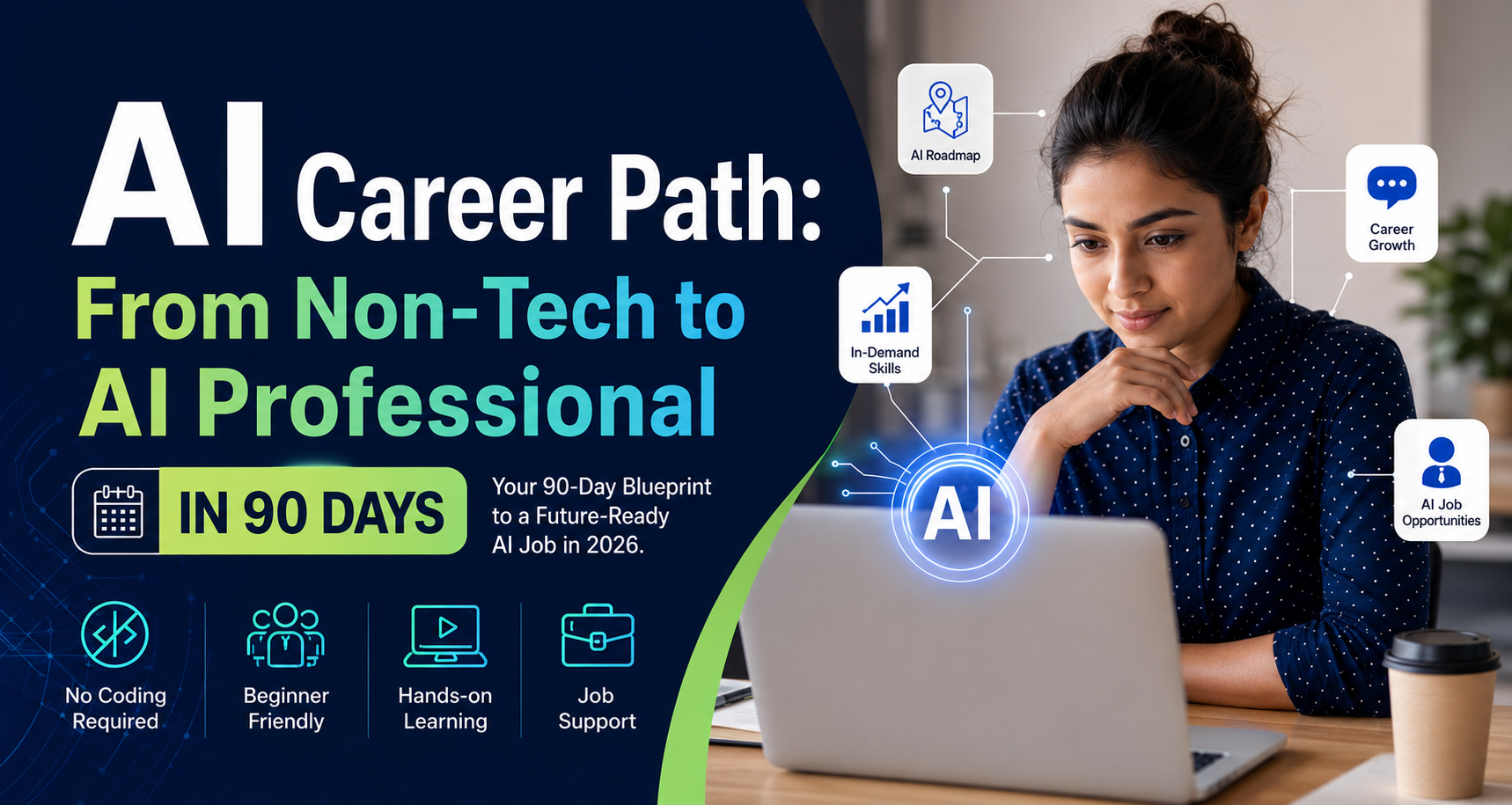
AI Career Path: From Non-Tech to AI Professional in 90 Days
Are you working in finance, marketing, HR, operations, or any other non-technical field? Are you curious about Artificial Intelligence (AI) but feel that your lack of a technical background keeps you from pursuing a career in this exciting industry? The truth is, the modern AI Career Path is far more accessible than you might imagine.
Thanks to rapid advances in user-friendly AI tools, low-code platforms, and specialised training programs, countless professionals are successfully transitioning into the AI field every single day. The AI Career Path is designed specifically for people like you — individuals who want to leverage their domain knowledge and pair it with AI skills to unlock a powerful career transformation.
Why AI Skills Are Essential in 2026
Artificial intelligence is no longer a futuristic concept. Businesses everywhere are actively seeking professionals who can combine domain expertise with AI capabilities to drive innovation and efficiency. Whether you work in a small business or a large corporation, understanding and applying AI tools is rapidly becoming a baseline expectation.
- Business processes are being automated at scale
- Replace repetitive tasks with smarter workflows
- Create higher-value job opportunities
- Command significantly higher salaries and career growth
The demand for AI-skilled professionals is growing at an unprecedented rate, and businesses across industries — from healthcare, finance, and retail to education, marketing, and logistics — are actively hiring. AI-savvy professionals can now do the work of entire teams, making them incredibly valuable in any organisation.
Understanding the Modern AI Career Landscape
While knowing your starting point matters, it is even more important to understand what the AI Career Path landscape actually looks like in practice. The field is divided into various roles suited for different types of professionals. Those with backgrounds in engineering or software development often pursue roles like Machine Learning Engineer or Data Scientist. However, non-technical professionals can successfully enter the field through Business AI roles, AI Tools Specialists, or Prompt Engineers.
We will be focusing on bridging non-technical backgrounds — particularly in sales, marketing, finance, customer service, and operations — with AI knowledge to create practical, job-market-ready professionals.
High-Demand AI Jobs for Non-Technical Professionals
Within the AI Career Path, several high-demand roles are specifically suited for non-technical professionals:
- AI Prompt Engineer: Creates precise instructions that maximise AI performance and productivity.
- AI Tools Consultant: Helps organisations identify and implement the most effective AI tools for their specific needs.
- AI Marketing Specialist: Uses AI-powered tools to run highly personalised, data-driven marketing campaigns and strategies.
- AI Business Analyst: Evaluates AI business solutions and translates complex data into actionable insights.
- AI Customer Success Manager: Empowers businesses to maximise the value they derive from AI-powered software products.
All of these roles share one powerful trait — they reward domain expertise and business understanding, qualities that non-technical professionals already have in abundance.
The Ultimate 90-Day AI Career Path
The AI Career Path is divided into three structured phases, each building directly on the previous one, giving you a clear and achievable roadmap to follow. Each phase takes approximately 30 days and includes specific learning objectives, hands-on projects, and self-assessment milestones.
The first month of your AI Career Path focuses on understanding AI concepts and becoming deeply familiar with the essential tools that will define your work. By the end of Phase 1, you will feel genuinely comfortable discussing AI concepts, tools, and applications with both technical and non-technical colleagues.
1. Learn AI Fundamentals
In the first stage of your AI Career Path, you need to build a solid conceptual understanding. Spend time learning:
- What artificial intelligence actually is and how it works
- Machine learning basics and deep learning tools
- Large language models (LLMs) and how they work
- Real-world AI use cases in your domain
- Automation workflows and where AI fits in
2. Master Essential AI Tools
Practical hands-on experience with AI tools is what truly propels this career path forward. Learn these tools:
- ChatGPT
- Claude
- Gemini
- Midjourney
- Perplexity
Spend a few hours every day actively experimenting with these tools. Explore them, break them, and find ways to apply them to real-world use cases.
3. Develop Prompt Engineering Skills
Prompt Engineering is one of the most valuable core skills in any AI Career Path. Learn how to:
- Write precise, clear, and effective prompts
- Create reusable prompt templates
- Chain multiple prompts together
- Iterate and refine outputs systematically
The second phase of your AI Career Path involves understanding how AI integrates directly into business processes, identifying real automation opportunities, and starting to build your first portfolio of AI projects. This is where your non-technical background becomes your biggest competitive advantage.
1. Understand Business Automation
Identify business processes that are ripe for disruption. Look for:
- Lead management
- Customer support
- Appointment scheduling
- Content marketing
- Data harvesting
- Email marketing
2. Learn No-Code Automation Platforms
No-code automation platforms allow you to build powerful AI-driven workflows without writing a single line of code. Focus on learning:
- Zapier
- n8n
- Make
- Notion AI
- HubSpot
- Voiceflow or equivalent
3. Build Your First AI Projects
Nothing strengthens your AI Career Path faster than real-world project experience. Try building these three projects:
- An automated lead-qualification system using AI prompts and CRM automation tools
- A content generation pipeline that creates blog posts, social media updates, and email campaigns
- A customer support chatbot that handles FAQs and routes complex queries to live agents
The final phase of your AI Career Path focuses on becoming a highly attractive candidate to employers and clients by building a strong professional portfolio, developing a credible online presence, and sharpening your interview skills.
1. Build a Strong AI Portfolio
- 4–6 completed AI projects with full documentation
- Project descriptions clearly explaining the business problem each one solved
- Measured results, such as "reduced response time by 60%" or "increased lead conversion by 35%"
- Demonstrated improvements (metrics by KPIs)
2. Establish a Professional Online Presence
- LinkedIn — optimise your profile for AI roles
- GitHub — showcase automation scripts and projects
- Personal website or portfolio site
- YouTube or blog — document your AI Career Path journey
3. Prepare for AI Job Interviews
You now need to be able to confidently answer questions like:
- Walk me through a specific AI project you built. What was the outcome?
- How do you identify a good use case for automation in a business?
- What are the challenges you faced, and how did you solve them?
- How do you measure the success of an AI implementation?
Practice answering these clearly using the STAR method (Situation, Task, Action, Result).
Essential Skills for a Successful AI Career Path
To succeed in this AI Career Path, there are three broad categories of skills you need to develop in parallel:
| Technical Skills | Business Skills | Human-Centred Skills |
|---|---|---|
| AI & Prompt Engineering | Project Management | Communication |
| No-code / Low-code Tools | Process Optimisation | Critical Thinking |
| Data Literacy | Client Management | Adaptability |
| Automation Platforms | ROI Measurement | Time Management |
| API Integrations (basic) | Use-Case Thinking | Strategic Thinking |
Common Mistakes to Avoid on Your AI Career Path
- 1Learning Too Many Tools Simultaneously: Focus on a small number of tools and learn them deeply before expanding your toolkit.
- 2Focusing Only on Theory: It is a fatal error to learn too much theory without actually building things. Projects are what differentiate you.
- 3Not Documenting Your Journey: Documenting your learning, projects, and achievements builds credibility with potential employers faster than any certification alone.
- 4Ignoring Business Context: An automation that eliminates an entire department's manual workload is far more impressive than one that saves a single step.
Career Opportunities After Following This AI Career Path
After 90 days of committed learning, creating projects, and building your professional presence, you will have unlocked significant career opportunities:
- AI Tools Specialist
- AI Marketing Manager
- AI Business Analyst
- Automation Consultant
- Prompt Engineer
- AI Customer Success Manager
Companies are no longer just looking for coders and data scientists. They are actively seeking business professionals who understand processes, can identify automation opportunities, and can translate AI capabilities into measurable business outcomes.
Why Choose Us?
Get full access to premium features for 7 days, completely free.
Full Access
Access all premium features without any restrictions
No Credit Card
Start instantly without providing payment details
Expert Support
Our dedicated team is always here to help you succeed
Cancel Anytime
No hidden charges or long-term commitments required
Conclusion
The rise of Artificial Intelligence is creating one of the biggest career shifts in the history of this generation. But it is not creating a divide between technical and non-technical people — it is creating a massive, once-in-a-generation opportunity for professionals from every background to reinvent themselves and step into high-demand, high-impact roles.
By following this structured, 90-day AI Career Path, you are not merely learning to use new technology. You are positioning yourself as a bridge between AI capabilities and real-world business applications — a role that is extraordinarily rare, highly sought-after, and financially very rewarding.
That professional can be you. Start your AI Career Path today and take the first confident step into the future of work.