
The Invisible Tax: How Delayed Invoicing Kills Cash Flow
The Silent Killer of Your Working Capital
If you’re running a small business, a trading firm, or managing accounts for a mid-sized organisation in India, you know the daily “invoice grind.” You raise a ledger entry in Tally ERP, generate the PDF, open your email, attach the file, type a polite note, and hit send — all while the phone is ringing and three other tasks demand your attention.
This traditional workflow is not just tedious; it is a significant bottleneck. Every minute of delay in sending an invoice contributes directly to your pile of outstanding receivables. In the fast-paced modern economy, manual entry and slow distribution are luxuries that small business owners can no longer afford.
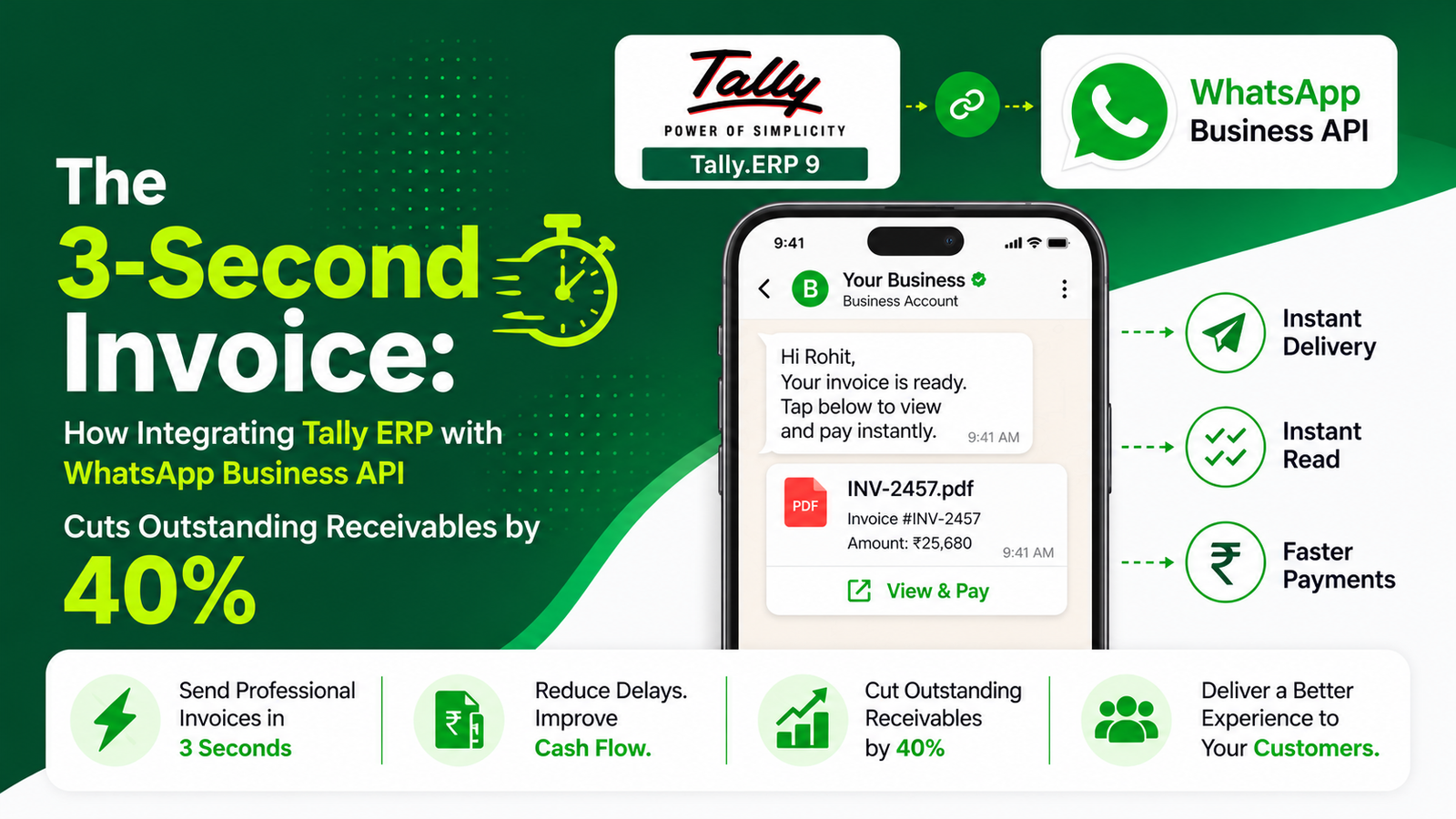
Businesses leveraging Tally–WhatsApp integration are cutting their outstanding receivables by up to 40%. The logic is simple: faster invoicing leads to faster payments. When an invoice reaches a client’s phone within seconds of a sale, the psychological readiness to pay is at its peak.
Every day you wait to send an invoice is a day your customer isn’t thinking about paying you. It is a common misconception that invoicing is just an administrative task. In reality, it is the primary trigger for your entire revenue cycle.
For small businesses, the opportunity cost of capital tied up in receivables is the “invisible tax” that hinders growth. When your funds are stuck in the ledger, you cannot reinvest in inventory, hire new talent, or capitalise on bulk-purchase discounts from your own vendors. This strain on cash flow forces many entrepreneurs to rely on expensive short-term credit lines — effectively paying interest on money they have already earned but haven’t collected.
Why Manual Invoicing Is a Bottleneck
The Friction That Inflates Outstanding Receivables
Data suggests that businesses that send invoices within 24 hours of a sale collect payments up to three times faster than those who batch their billing weekly or monthly. When you rely on traditional manual workflows — exporting, downloading, attaching, and emailing — you create friction that impacts both your team and your client.
1
Email Dependency
Invoices sent via email are easily buried under hundreds of other messages, filtered into “Promotions” or “Spam” folders, or ignored during a busy workday. Even when delivered, they require the client to be at a desk to process the payment.
2
The “I Never Received It” Excuse
Manual processes offer zero real-time delivery confirmation. When a payment is late, you have no way of knowing if the client truly didn’t receive the invoice or simply ignored it. This leads to awkward, time-consuming follow-up calls that drain your staff’s productivity.
3
Batch Billing Delay
Grouping invoices into weekly or monthly batches disconnects the invoice from the moment of purchase — eroding the customer’s sense of urgency to pay and stretching your collections cycle unnecessarily.
The Real-World Cost of Friction
Cash Flow Gaps That Paralyse Growth
Cash flow gaps do more than just sting — they can paralyse a business. When your liquid capital is trapped in outstanding receivables, you lose the ability to negotiate.
- Delayed payments to your own vendors, damaging your credit reputation
- Lost “early bird” discounts from suppliers — effectively free money left on the table
- Reliance on expensive short-term credit to cover operational costs
- Reduced ability to invest in inventory and growth opportunities
The Mechanics of Speed: How Tally–WhatsApp Integration Works
Real-Time API Integration — Not a Bulk Messaging Hack
The “magic” behind the 3-second invoice isn’t magic at all — it is a sophisticated middleware API layer that bridges Tally ERP’s robust accounting engine directly with the WhatsApp Business API.
Unlike old-school methods where an accountant manually exports a CSV, cleans the data in Excel, and uploads it to a bulk messaging tool, an API-based integration works in real-time. Manual exports are prone to human error — a typo in a phone number or a shifted column can lead to invoices being sent to the wrong person with incorrect amounts. With a direct API connection, data is pulled instantly from the source of truth (Tally), ensuring what you see in your books is exactly what the customer sees on their phone.
- Automatic Trigger: The moment your accountant saves a sales voucher in Tally ERP, the integration recognises the event immediately. No extra buttons, no exports.
- Data Extraction & Validation: The system pulls customer name, invoice amount, due date, and line items directly from your Tally database, validating contact information against your ledgers for 100% accuracy.
- Instant Delivery: The data is formatted into a professional PDF or message and pushed through the WhatsApp Business API. Within seconds, it pings on the customer’s phone.
Your team doesn’t need to touch anything after posting the entry. The invoice lands in the customer’s WhatsApp chat — a space they monitor constantly throughout the day — looking clean, professional, and immediately actionable.
Why Your Customers Actually Pay Faster on WhatsApp
Meeting Your Customers Where They Live
It’s about meeting your customers where they live. Email open rates for business-to-business communications typically hover around a disappointing 20–25%. In contrast, WhatsApp messages see open rates as high as 98%, usually within three minutes of delivery.
In the Indian context specifically, WhatsApp has become the primary tool for commerce. When an invoice arrives in a familiar environment, it feels less like a “bill” and more like a continuation of a professional conversation — significantly reducing the psychological barrier to payment.
- Peak Motivation: When a customer sees an invoice immediately after a purchase, the payment conversation begins while the value of your work is still fresh in their mind.
- One-Click Payments: By embedding UPI, Razorpay, or PayU links directly in the WhatsApp message, the customer taps the link, authorises via their preferred UPI app, and the transaction is complete in seconds.
- Double Blue Tick Accountability: You get real-time read receipts. You know exactly who has seen the invoice and when — transforming your follow-up from a guessing game into a targeted, data-driven strategy.
Scaling Your Collections: From Manual Chasing to Automated Efficiency
What Works for 50 Invoices Fails at 500
As your business grows, the number of invoices you generate increases exponentially. When you shift from manual chasing to automated WhatsApp delivery, your finance team gains back hours of productive time every week — transforming them from “collection agents” into strategic contributors.
A
Automated Reminders
Configure the system to trigger personalised nudges at specific intervals — 3 days before the due date, on the day, and 7 days after. These feel like a helpful service, not a robotic demand.
B
Targeted Follow-ups with Delivery Data
Granular WhatsApp delivery data lets you prioritise calls for high-value clients who haven’t even opened the message — ensuring your team’s energy is spent where it yields the highest return.
C
Real-Time Reporting & Analytics
When invoicing and messaging systems are synced, you gain a dashboard showing receivables health at a glance. Track Average Days Sales Outstanding (DSO), identify your slowest-paying customer segments, and turn gut feelings into actionable financial intelligence.
WhatsApp Collections Starter Kit
Everything you need to automate your invoicing from Tally and start collecting faster — sent straight to your inbox.
Configure your Tally trigger and field mapping step by step
Professional, approved invoice & reminder templates ready to use
Ensure every invoice carries a working one-tap payment link
Measure your Days Sales Outstanding before and after going live
Implementing the Solution: A Step-by-Step Guide
Your Roadmap to the 3-Second Invoice
Ready to modernise your receivables process and eliminate the invisible tax? Follow this implementation roadmap:
- 1. Choose the Right Integration Partner. Look for an established WhatsApp Business API provider that specialises in accounting software connectors. Ensure the platform supports two-way messaging and provides audit-ready delivery receipts. A partner with deep Tally ERP expertise will save countless hours during setup.
- 2. Configure Your Tally Trigger & Templates. Work with your provider to set up the necessary TDL (Tally Definition Language) scripts. Map your Tally fields — customer names, ledger balances, and invoice line items — to your WhatsApp message templates. Precision here ensures every automated invoice is perfectly accurate.
- 3. Professionalise Your Communication. Your WhatsApp message is an extension of your brand. Ensure your company logo is visible and the text body is clear and polite. Use a simple Call to Action: “Tap the link below to pay via UPI or reply to this chat if you have any questions.” Encourage immediate engagement.
- 4. Test, Refine, and Scale. Before going live with your entire client list, run a pilot. Send test invoices to your internal team to check formatting on Android vs. iOS. Verify payment links redirect correctly and read receipts update in your dashboard. Then roll it out to your most frequent customers first.
Pilot the integration with 10–15 of your most active customers before a full rollout. This gives you real-world feedback on message formatting, payment link performance, and customer response — so you can refine your templates before they go out to your entire contact list.
Conclusion: Build Your Financial Ritual
Ghost inventory rarely announces itself — it hides inside a balance sheet that still looks profitable. TallyPrime’s Ageing Analysis and Godown Summary reports give you the visibility to find exactly where capital is stuck, item by item and warehouse by warehouse.
From there, the fix is a combination of better supplier conversations, data-driven reorder levels, and simple weekly habits — a 30-minute Monday review, monthly physical audits, and a one-page response plan your whole team can follow.
Don’t wait for a cash crunch to discover where your money is sitting. Run the Ageing Analysis this week, fix the imbalances it reveals, and build the weekly habit that keeps ghost inventory from coming back.